
We love hearing from our customers and future customers when they have a question on our products. We are always eager to ensure that they have the proper information to make an informed buying decision or that their technical questions have been answered clearly and concisely.
We have taken some of the most popular questions and put them together in the hopes that they can help others who have similar questions.
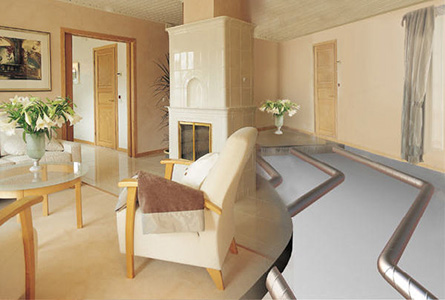
The cost difference between Gas and Electricity for conventional forced air-heated systems can be found at the following link: http://www.uniongas.com/residential/naturalgasproducts/heating/costcomp.asp
With Legalett Air Heated Floors you will reduce the energy requirements of your home by approx. 15-20% when compared to conventional Forced Air Systems, since the average room temperature can be reduced while maintaining the same level of comfort.
In Ontario, Hydro One will be installing Smart Meters before the end of 2010, which will enable you to purchase electricity at off peak rates.
See here for more information and frequently asked questions on Smart Meters in Ontario.
We have an Electric heater and a Water Coil heater. The Water Coil unit can be used when your heating source is oil, propane, natural gas, solar-boosted, wood or geothermal.
In the case of oil, propane or natural gas, a domestic hot water heater is all that is needed. In some areas where 2 tier electric rates are available the Electric unit maybe more attractive.
Electric is the most efficient method of heating since it is 100% efficient. That does not mean it is the least expensive.
In some locations utilities provide multi tier rate structures for electricity, because of this we see a greater demand for electrical units for the reason you suggest (less expensive to install). Bear in mind that the thermostats we supply have built in timers, so when the demand for heat is present, the heating unit will only come on during off peak rates. The water coil unit requires a hot water heater and additional costs for a pump and piping. On a small home, the additional costs of a fuel-fired hot water heater may take many years to pay back.
All tankless hot water heaters are well sized for domestic but could be oversized for Legalett. Our 3kW heater when zoned, could demand 1.5 kW only or about 150 L/hour at 60°C with a return water temperature of 48°C. – this is much less than domestic hot water demand.
Please note that domestic hot water supply would take precedence over heating requirements. When choosing a tankless heater ask about the minimum firing rate or turn down ratio to make sure the unit is not oversized and cycling excessively.
Boiler can be as far as you want – there is no restriction that we can think of outside of hydraulic issues with pressure drop and line sizing.
Any energy source can be used. We have an electric or water coil heater. The water coil heater can be supplied with hot water from any heat source including geothermal, solar, hot water heater, boiler (fired on natural gas, propane, or oil). We have some installations where we have run piping through a masonry fireplace to pick up heat and distribute to the building. See our Heater Data sheet here for more details.
Our standard supply is 10 Btu per hour per square foot – this should be enough for most homes. Our system is a low intensity system – which means we trickle energy into the slab – the slab acts as a large radiator and is capable of delivering a huge amount of energy into the building as required. We maintain the system performance at a level where the floor temperatures are comfortable.
If you want to compare Hydronic with the Legalett System please see the followings links:
Legalett Slab on Grade Shallow Foundations vs. Hydronic & Conventional Heating Systems
Cost Comparisons of Legalett Slab on Grade Shallow Foundations vs. Hydronic & Conventional Heating Systems
Yes, we have a 2 inch system that is perfectly suited for second floor applications. Please refer to our Typical Design Details for Suspended Floors Specification Sheet here.
Yes, we have suspended floor systems. Typically we use either EPS-Deck Concrete Deck Forming System or Hambro structural systems for suspended floor pours. In your situation it seems that you would most likely use EPS-Deck as the stay-in-place form work (also to provide insulation under the slab).
One of our heaters would cover approx. 1400-1700 sq. ft. Legalett would locate the position of the heater box (s) during the design phase unless you have a preference. We like to locate the box in a central location – in a closet or under a stairway if possible although not required.
We have electric furnace and a water coil furnace. The water furnace can be supplied with hot water from a hot water heater, boiler, etc. It is a simple installation. For more information see Legalett’s Typical Design Details for Water Coil Heater Installations.
The location of the heater box in the floor is also straightforward. Ideally it should be located in a central location (but not necessary), it can even go in the middle of a room since the top access cover can be finished to match the floor covering. However, we suggest a closet location for ease of installation and access.
Our 4 inch piping system uses a spiral wound pipe for two reasons – first there is improved heat transfer since air turbulence is increased, second structurally through the pour the pipe maintain its integrity.
Legalett is a closed loop system. The air you breathe is separate from the air you heat with. When running an open loop system with ducting through a slab, you would need to be concerned about condensation, this scenario would require a trap at each duct to remove any collected water from the loop, otherwise the ducting would eventually rust and the air quality would become a health concern.
The electric inserts use electric coils to heat the air, whereas the water coil units use air/water heat exchangers to heat the air. For the water coil units a standard hot water heater/boiler would suffice and a circulating pump would be needed (grundfos) only – For more information see Legalett’s Typical Design Details for Water Coil Heater Installations.
Yes, the slab does have to be heated all year around to prevent frost heave. If you are using a cottage for a week or two in the winter, one can set the temperature lower when not there, but it will take a couple of days for the temperature to rise to comfort levels on arrival. If you lower the temperature when not in use to say 15°C and then increase to say 19°C when in use – you would arrive at a comfortable temperature over 24 hours.
Occupancy and use of building should be known at the design stage. If you are not planning to use the building over the winter then the slab design would change. Legalett also supplies an unheated slab for heated buildings and an unheated slab for unheated buildings, designed for cottages that will freeze.
It is very difficult to provide heating costs for electric units – we have some data for water coil units in assembly buildings. Electricity is used for cooking, hot water heating ( in some cases), lights, etc. – to monitor electric heating costs would require a separate meter on the heating unit alone – and if we had this data – what could we compare it to? – We would need an identical home- with the same occupants with the same habits during the same time period and weather. Please refer to the Air-Piping Layout Design Specification Data Sheet for a natural gas based residence – the owner was very keen on recording energy costs in this case.
We can say this: With a Legalett home – the building has a completely insulated envelope – reducing energy losses to the ground. Because of temperature stratification – the air temperature at the ceiling is about 4-5°C lower than with conventional forced air heating resulting in a lower delta T across the ceiling and walls again reducing energy losses.
When your feet are warm the average temperature in the home can be reduced by 2-3°C again saving energy. Now if we put this together in an average year say in Ottawa, Canada this would amount to about 15% minimum energy savings over the heating season. Please refer to Legalett’s Energy Savings Comparative Data Sheet here.
Our 4000 series heating units cover approx. 1400-1700 sq. ft. at 10 Btu per hour per square foot. We basically sell 10 Btu’s per hour per sq. ft. or more if the customer requests it. We check the heating requirements for the building to make sure the heating demand would be met with the installed heater for conduction losses and a 0.12 Air Changes per hour allowance for infiltration ( this corresponds to a well built home – R2000 quality). We do not allow for any heat losses due to ventilation and for this reason we do not take responsibility for the total building energy requirements. Building codes often require make-up air or exhaust air etc. usually through HRV’s . The building mechanical designer should take a look at the total building heating requirements including ventilation. Touch up heat is required for the ventilation air. Please refer to the HRV/ERV Operation with Legalett’s Energy Savings Comparative Data Sheet here.
When using a radiant heated floor coupled with the thermal mass that a Legalett foundation will give you – you will not be subject to drafts or temperatures swings in your home. When you open a door and get a blast of cold air coming into the house – you will feel cold but when that door is closed instantly you will feel warm again because the floor will radiant the required energy to you. The outside temperature may vary considerably – the slab will only impart the energy that is needed to maintain comfort – it will not over heat and it will not drop in temperature significantly to cause you to notice -hence the benefit of radiant heat. We do not recommend varying the thermostat once comfort level has been attained whether the temperature outside changes or not. The heat recovery ability of the system is sized for extremes so the indoor temperature will not vary outside of the control range.
Legalett is a low intensity heated floor system – which means we trickle energy into the floor slowly. You would not normally notice that the heater is running due to the quiet operation, but when the heater does come on it will stay on for a few hours to replenish the energy in the slab.
Yes, Legalett can and has been used for many home additions including sunrooms. If the elevation is higher we would suggest to bring in clear stone (after removal of the topsoil) to set the slab EPS on. Our standard edge element is 14 inches (6 inches of EPS and 8 inches of concrete) and we would like it buried at least 6 inches. Depending on the heating requirements for the sunroom or if you decide on a unheated slab we would possibly skirt the room with EPS and would want the skirting to be buried also. Some landscaping may be required.
Legalett is not suited for retrofitting existing buildings, unless existing floors can be excavated. The Legalett system is suitable for:
New construction and
Yes, we can work with you directly – if you install yourself or have your own contractor. In this case we would make arrangements for a pre-pour inspection with a Legalett Representative. In the later case we would train your contractor to become one of our installers in your area.
We have supplied our standard slab on grade warm floor system to many states including California, Nevada, Utah, Michigan, Pennsylvania and New York. Our standard slab on grade design requires an engineer’s stamp in Canada as well as the USA. We have available an alternate design that is IRC compliant (International Residential Code) which has been adopted by many states and would not require an engineers stamp. However, most customer prefer our standard design because of its’ simplicity.
Legalett is very well suited to ICF Construction for 2 or 3 storey homes. We have many back walk-outs on sloped property – Legalett can be designed to suit the location.
Yes, Legalett has been the system of choice when faced with rock outcrops.
The Legalett system is designed for typical edge loading of up to 5000 lbs. per linear foot. Legalett designers/engineers can design up to 3 stories of ICF walls & suspended floors.
We provide a complete design for building permitting. Our designs fall under Part 4 of the NBC and are stamped by a P.Eng. with a BCIN. All bearing walls are accounted for during design for our slab on grade system.
Each structure is custom designed – point loads, large bearing areas and/or piers can be and have been many times incorporated into our designs, depending on the structural requirements.
Our system has the ability to bridge poor soils and lies very lightly on the ground – the resultant loads are very light – in the area of 1000 psf or lower. However, this does not mean that you should ignore good engineering practices when building. It is important to have a uniform substrate below the slab – either all dirt or all rock with a layer of clear stone leveled when placing the EPS. It is recommended to have a soils engineer provide some assistance to you knowing the loading that Legalett requires. Please refer to the Problem Soils Data Sheet here for more information.
Yes, many of our customers use hard wood flooring and today with the engineered products available most are very compatible with Legalett. Please refer to the following links:
Any floor covering can be used. If you chose an insulative floor covering such as thick carpet with a foam backing or hardwood on sleepers we would like to know about it at the design stage. For further information please see the Legalett Floor Finishes Specification Sheet here.
A Legalett Service Rep or any licensed electrician or heating contractor can service the unit.
There is no regular maintenance required. Once a year the cover and heating unit should be exposed and visually inspected.
This question could apply to any heating supply company. All parts in the Legalett heating unit are universal. Legalett is supplied worldwide. In North America we warehouse complete spare inserts as well as components. After market parts can be purchased through our On-line Parts Catalog. We have units in continuous service for over 20 years.
Legalett is not a H&V design company. We do not do heat load calculations as part of our supply. We use our own proprietary software to evaluate transmission and stated infiltration losses, as an internal check only to make sure that the heating system sizing, as chosen by the party who actually does the heat loss, is sufficient. Ventilation and excessive infiltration losses are by others. Ventilation varies from region to region and we do not supply ventilation systems – for this reason we do not do whole-house heat losses. We sell basically 10, 15, or 20 Btu’s per square ft. per hour – and perform an internal check for the Legalett heated area to make sure that the system is sized correctly.
The air circulated by the heating unit does not enter the living space. Ventilation air must be provided from a separate ventilation system, especially for commercial or institutional buildings where large volumes of fresh air are required for occupancy loads The Legalett System is typically designed to have a heat output to meet transmission losses and .12 Air Changes per hour for infiltration (R2000 Quality Construction Building).
Heating of ventilation air (ie. ventilation losses) must be done by external ventilation units. The magnitude of energy required to heat the ventilated fresh air in an occupancy building is typically an order of magnitude beyond what is required to provide “comfort” heat. The slab cannot be used to provide the heating of fresh air.
In other words, during periods of non-occupancy, when the ventilation system can be shut down, the Legalett slab will provide the heating needs, along with providing a comfortable warm floor, by matching the transmission heat losses of the building’s lower floor. Since the ventilation system is turned off, there are no ventilation losses. During periods of occupancy, the ventilation system has to be turned on, along with its integral heating of the fresh air.
Refer to the following product data sheets for a discussion on HRV operation in Radiant Floor Heated homes;